
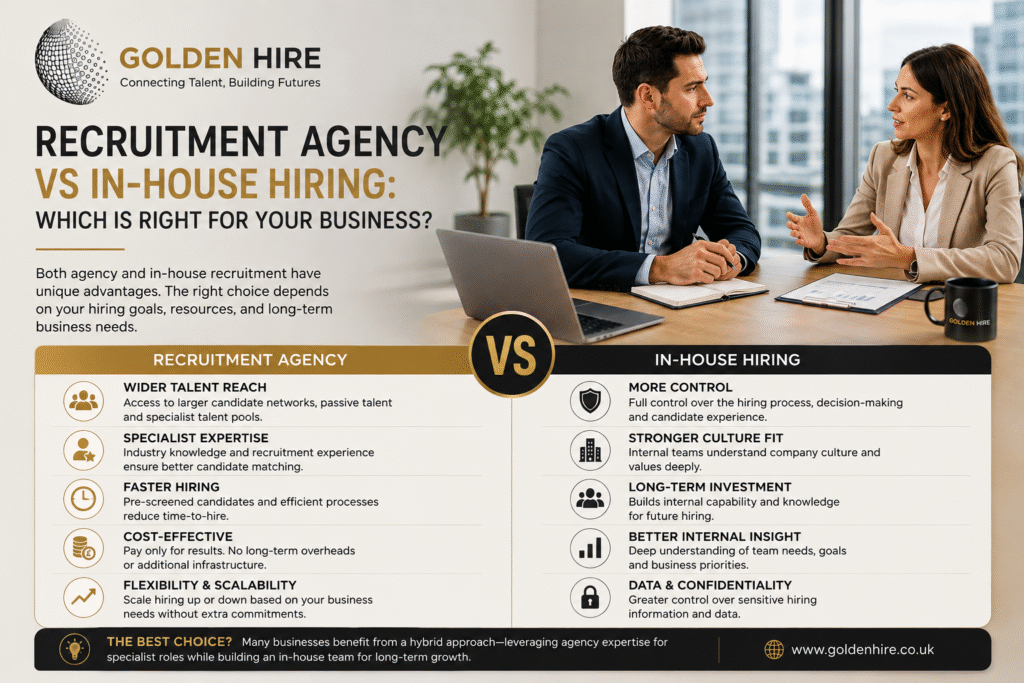
Recruitment Agency vs In-House Hiring: Which Is Right for Your Business?
Recruitment is one of the most important functions within any growing organisation because the people a business hires can influence productivity, service quality, team performance and long-term growth. However, before an employer begins reviewing CVs or interviewing candidates, there is an important strategic decision to make: should the recruitment process be managed internally, or should the organisation work with an external recruitment agency? The recruitment agency vs in-house hiring decision is not simply about choosing the cheapest recruitment method. It involves considering the organisation’s hiring volume, internal resources, candidate reach, specialist requirements, time constraints and the complexity of the vacancies being filled.
For UK businesses, both approaches can offer genuine advantages. An established internal recruitment team can develop detailed knowledge of the organisation, its culture and its recurring hiring requirements. A recruitment agency, on the other hand, can provide additional sourcing capacity, access to wider candidate networks and specialist recruitment knowledge when an employer does not have sufficient resources internally. This is particularly relevant for businesses that recruit irregularly, are expanding quickly or need professionals in areas where suitable candidates can be difficult to identify.
Golden Hire supports employers by helping connect businesses with relevant candidates while allowing organisations to retain control over their final recruitment decisions. Rather than treating agency recruitment as a replacement for internal HR or talent acquisition, employers can use external recruitment strategically where it adds value. Understanding the strengths and limitations of each model is therefore essential before deciding which recruitment approach is right for a particular business.
What Is In-House Hiring?
In-house hiring means that recruitment is primarily managed using an organisation’s own employees, systems and resources. In a large company, this may involve a dedicated talent acquisition department with recruiters responsible for sourcing candidates, managing applications, conducting initial screening and coordinating the interview process. In smaller businesses, recruitment responsibilities may sit with an HR manager, departmental manager or business owner alongside their other duties.
The principal advantage of in-house recruitment is organisational knowledge. Internal recruiters work directly within the company and can develop a detailed understanding of its departments, management structure, workplace culture and long-term workforce requirements. This can be particularly valuable when an organisation recruits similar positions regularly because the recruitment team can gradually build candidate pipelines and understand the qualities that are relevant to each department.
However, an internal recruitment process still requires significant resources. Recruiters need access to job advertising platforms, candidate sourcing tools, applicant tracking systems and sufficient time to communicate with candidates. Hiring managers must also review applications, conduct interviews and participate in selection decisions. For organisations with regular hiring activity, investing in these capabilities can make commercial sense. For companies recruiting only occasionally, maintaining the same level of permanent recruitment infrastructure may be less practical.
What Does a Recruitment Agency Do for Employers?
A recruitment agency provides external recruitment support to organisations that need help identifying and engaging potential candidates. The precise service depends on the recruitment provider and the vacancy, but it may include understanding the employer’s requirements, sourcing candidates, reviewing professional backgrounds, conducting initial screening and presenting relevant applicants for consideration.
The purpose of a professional recruitment agency should not simply be to send employers as many CVs as possible. Application volume has limited value when candidates do not meet the requirements of the position. Effective recruitment is based on relevance, which means understanding what the employer actually needs and focusing the search on professionals whose experience and capabilities have a reasonable connection with those requirements.
This is an important part of the approach taken by Golden Hire. Employers need candidates who make sense for their vacancies, while professionals need opportunities that correspond with their skills, experience and career ambitions. External recruitment can help strengthen this connection when an employer lacks the time, resources or candidate reach required to conduct a comprehensive search independently.
Recruitment Agency vs In-House Hiring: What Is the Main Difference?
The main difference between recruitment agency vs in-house hiring is where recruitment capability sits. An in-house model requires the organisation to build and maintain its own recruitment resources, while an agency model allows the employer to access external expertise and sourcing capacity when required. Neither structure is inherently superior because their effectiveness depends heavily on the organisation’s recruitment needs.
A company recruiting throughout the year may benefit considerably from an internal talent acquisition function. Recruiters can work closely with managers, develop knowledge of recurring vacancies and establish long-term candidate pipelines. When hiring demand is consistent, the cost of maintaining an internal recruitment team can also be distributed across a larger number of appointments.
The situation can be very different for an SME that recruits only a handful of professionals each year. Building specialist recruitment expertise internally for occasional vacancies may require resources that are difficult to justify. External recruitment can provide access to additional capability without requiring the organisation to permanently employ recruiters for hiring demand that may fluctuate considerably.
For this reason, businesses should avoid viewing agency and in-house recruitment as competing philosophies. They are different ways of accessing the resources required to find suitable people.
Recruitment Agency vs In-House Hiring: Comparing the Real Costs
Cost is one of the most frequently discussed factors when employers compare recruitment agency vs in-house hiring. Recruitment agency fees are generally visible because they are associated directly with the recruitment service or successful placement. This can make agency recruitment appear more expensive at first glance. However, comparing an agency fee only with the cost of posting a vacancy does not provide a complete financial picture.
In-house recruitment also creates costs. An internal recruitment function may involve salaries, employer contributions, recruitment software, job advertising, sourcing platforms and other recruitment technology. There is also the value of the time spent by HR teams and hiring managers reviewing applications, communicating with candidates, conducting interviews and coordinating decisions. These costs are often distributed across departmental budgets rather than appearing as a single recruitment expense.
For organisations making a high volume of appointments, internal recruitment can be commercially efficient because the infrastructure is being used continuously. For businesses making occasional appointments, particularly specialist hires, an external recruitment service can sometimes provide more flexibility because the employer pays for recruitment support when it is actually required.
The most useful cost comparison is therefore not simply whether an agency charges a fee. Employers should consider the total resources required to identify, assess and appoint an appropriate candidate using each method, as well as the potential business impact of leaving an important vacancy open for an extended period.
Candidate Reach: Where Recruitment Agencies Can Add Value
One of the most significant differences between internal hiring and agency recruitment concerns candidate reach. Advertising a vacancy can work extremely well when there is a healthy supply of relevant professionals actively searching for employment. However, the available talent market is usually broader than the group of people currently submitting applications through job boards.
Some suitable professionals may already be employed and not actively applying for vacancies. They may still consider an opportunity if it offers the right responsibilities, progression or working arrangements. Reaching these candidates can require proactive sourcing rather than waiting for applications to arrive.
Experienced internal recruiters can certainly conduct direct sourcing. Larger employers often maintain sophisticated talent acquisition teams capable of identifying and engaging professionals across different markets. Smaller organisations, however, may not have the same recruitment tools, databases, networks or time available.
This is where the recruitment agency benefits can become particularly relevant. An external recruiter can extend an employer’s existing candidate search and potentially introduce professionals the organisation may not have reached through its normal advertising channels. Golden Hire can support this wider search by helping employers connect with candidates beyond the immediate pool generated by a conventional vacancy advertisement.
Recruitment Agency vs In-House Hiring for Specialist Roles
The difference between recruitment models becomes particularly important when a vacancy requires specialist knowledge or experience. An internal recruiter can have an excellent understanding of the organisation while still having limited exposure to a particular external candidate market. This can happen when a company needs to recruit a position that falls outside its normal hiring activity.
For example, a business that usually recruits administrative, customer service or commercial employees may suddenly require a specialist finance, compliance, technology or senior professional. The internal team may understand the organisation extremely well but have limited familiarity with the terminology, career pathways and candidate expectations associated with that profession.
A specialist recruitment agency UK businesses engage for these circumstances can potentially add external market knowledge to the organisation’s existing internal understanding. The employer remains the expert on its own business and the responsibilities of the vacancy, while the recruiter contributes experience of candidate sourcing and the relevant employment market.
This collaborative model is important to Golden Hire’s role in recruitment. External recruitment should not undermine the employer’s internal knowledge. It should complement that knowledge where additional candidate reach or recruitment expertise is useful.
Which Recruitment Approach Gives Employers More Control?
In-house hiring provides employers with a high level of direct control over the recruitment journey. Internal recruiters can communicate continuously with managers, adjust requirements when necessary and provide candidates with first-hand information about the organisation. They can also align recruitment activity closely with internal workforce planning and employer branding.
This direct involvement is a genuine advantage, particularly for organisations with well-developed recruitment departments. Candidates may appreciate speaking directly with someone who understands the company’s working environment, culture and career development opportunities from inside the organisation.
Using an external recruiter does not, however, mean that the employer gives up control over the appointment. A recruitment agency can source and screen candidates, but the organisation should still determine the essential requirements, decide which applicants progress, conduct its own interviews and assessments, and make the final hiring decision.
The strongest relationship between an employer and Golden Hire should therefore be collaborative. The employer retains authority over who joins the organisation, while external recruitment support helps make the candidate search more manageable and focused.
Recruitment Agency vs In-House Hiring: Which Is Faster?
Recruitment agencies are often associated with faster hiring, but the reality depends on the circumstances. An experienced internal recruitment team can be extremely efficient when filling positions it manages regularly. If recruiters already understand the vacancy and maintain relationships with potential candidates, introducing an external provider may not make the process significantly faster.
Agency recruitment can become particularly useful when an organisation encounters an unexpected or unfamiliar requirement. An urgent replacement, new specialist position or sudden period of expansion can create recruitment demand beyond the normal capacity of the internal team. External support can provide additional sourcing resources without requiring the business to permanently increase recruitment headcount.
However, speed should never become the only measure of recruitment success. Filling a vacancy quickly provides limited value if the appointment is poorly matched to the responsibilities involved. Employers should instead aim for an efficient process that removes avoidable delays while maintaining appropriate candidate assessment.
How Golden Hire Can Support Growing UK Businesses?
Growth can make recruitment requirements difficult to predict. A small business may initially make only a few appointments each year, allowing managers or HR employees to handle recruitment alongside their normal responsibilities. As the organisation expands, that model can become increasingly difficult to maintain.
At the same time, immediately creating a large internal talent acquisition team may not be commercially appropriate. Hiring demand can fluctuate considerably, particularly when growth is linked to new contracts, investment, seasonal requirements or expansion into new markets.
External recruitment can provide flexibility during these periods. Instead of maintaining enough permanent recruitment capacity to manage peak demand, employers can use additional support when required. This can make outsourcing recruitment UK activity particularly relevant to growing SMEs and organisations experiencing changing workforce requirements.
Golden Hire can support employers in these situations by complementing their existing recruitment process. The organisation continues to control its workforce planning, interviews and final decisions while gaining additional resources to help identify relevant candidates.
Employer Branding and the Candidate Experience
Employer branding is another important consideration when comparing in-house recruitment vs agency. Internal recruiters can often communicate an organisation’s culture and working environment in considerable detail because they experience the business directly. This can help candidates understand not only what the job involves but also what it may be like to work for the organisation.
A recruitment agency represents the employer during part of the candidate journey, which means the quality of that representation matters. Candidates should receive accurate information about the vacancy, realistic expectations and professional communication. Poor external communication can damage an employer’s reputation just as easily as a poorly managed internal recruitment process.
Businesses choosing a recruitment agency for employers UK should therefore consider candidate experience alongside candidate sourcing. The way a recruiter communicates with potential applicants can influence how those individuals perceive the employer before they ever attend an interview.
When In-House Recruitment Is the Better Choice
There are many situations where in-house recruitment is likely to be the most practical approach. Organisations with high and predictable recruitment volumes can benefit from maintaining dedicated internal recruiters who understand recurring vacancies and develop long-term candidate pipelines. This can create both operational efficiency and detailed organisational knowledge.
Internal recruitment can also be particularly effective where the company already has strong access to the required talent market. If relevant candidates regularly apply directly, internal recruiters have sufficient sourcing capabilities and managers are satisfied with the quality of appointments, there may be little commercial reason to involve an external agency for routine vacancies.
Employer branding can provide another reason to keep recruitment internal. Organisations that compete heavily on workplace culture, development opportunities or employee experience may prefer direct candidate communication throughout the entire hiring journey.
An authoritative comparison of recruitment agency vs in-house hiring should therefore recognise that agencies are not necessary for every vacancy. External recruitment is most useful when it solves a specific hiring challenge rather than simply adding another participant to an already effective process.
When Golden Hire Can Add Greater Value?
There are also situations where external recruitment support can make practical sense. An employer may have advertised a vacancy repeatedly without reaching appropriate professionals. The internal team may be dealing with an unusually high number of vacancies, or the organisation may require a specialist candidate outside its normal recruitment market.
Smaller businesses may face an additional challenge. They often need high-quality employees but do not recruit frequently enough to maintain a permanent team of specialist recruiters. In these circumstances, using Golden Hire can provide access to recruitment support when required without the organisation having to build every part of the recruitment function internally.
The key is to use external recruitment strategically. A business does not necessarily need an agency for every vacancy simply because one specialist role requires support. Straightforward positions can continue to be handled internally while external recruitment is reserved for vacancies where additional candidate reach, market knowledge or sourcing capacity is likely to provide meaningful value.
The Hybrid Model: Combining In-House Recruitment With Golden Hire
The recruitment agency vs in-house hiring discussion often creates the impression that businesses need to choose one approach permanently. In practice, a hybrid model can be more effective for many employers.
An internal recruitment team can manage regular, high-volume and graduate vacancies while external recruiters support specialist or difficult-to-fill appointments. Similarly, an SME may handle routine recruitment independently but work with Golden Hire when it needs additional candidate reach or does not have sufficient time to conduct a specialist search.
This approach allows employers to preserve the advantages of internal recruitment while gaining access to external resources when required. It can also help organisations manage recruitment expenditure more deliberately because agency support is focused on the vacancies where it is most likely to provide value.
A hybrid recruitment strategy is therefore not a compromise between two models. For some businesses, it can be a deliberate workforce strategy that allocates recruitment resources according to the complexity and urgency of each vacancy.
How to Decide Which Recruitment Model Is Right for Your Business
The right recruitment model should be determined by the organisation’s actual hiring requirements. Businesses should first consider how frequently they recruit and whether their recruitment volume is consistent throughout the year. Regular hiring can justify investment in internal talent acquisition, while irregular recruitment may make flexible external support more practical.
The complexity of vacancies should also be considered. If an organisation regularly hires the same types of employees and already understands the relevant candidate market, internal recruitment may be sufficient. When a position requires specialist expertise or candidates are difficult to reach through conventional advertising, external recruitment may provide additional value.
Employers should also examine internal capacity. An HR department may be highly capable but already responsible for employee relations, onboarding, policies, performance management and other business functions. Asking the same team to manage multiple urgent vacancies can create pressure even when the organisation technically has internal recruitment capability.
Finally, the cost of an unfilled vacancy should be considered alongside recruitment expenditure. A critical position that remains vacant for several months can affect workloads, projects and business capacity. The cheapest recruitment method on paper is not necessarily the most commercially effective if it significantly extends the time required to reach suitable candidates.
Why Golden Hire Focuses on Relevant Recruitment?
Modern recruitment technology makes it relatively easy to advertise a vacancy and receive applications. The harder challenge is ensuring that those applications are relevant.
Employers generally do not need hundreds of CVs. They need a manageable group of candidates whose experience, skills and career backgrounds provide a reasonable basis for further assessment. Candidates similarly benefit when they can focus on opportunities that correspond with their capabilities rather than applying indiscriminately across the market.
This is where Golden Hire can provide value as part of an employer’s recruitment strategy. The objective is to help create stronger connections between businesses seeking talent and professionals seeking suitable opportunities. External recruitment should ultimately make the hiring process more focused rather than simply increasing its volume.
A strong recruitment strategy therefore depends on clarity from both sides. Employers need to define what they genuinely require, and recruitment partners need to understand those requirements before identifying candidates. When this relationship works effectively, businesses can spend more of their time assessing credible potential hires and less time processing unsuitable applications.
Recruitment Agency vs In-House Hiring: Which Is Right for Your Business?
There is no universal winner in the recruitment agency vs in-house hiring comparison. In-house recruitment can provide excellent organisational knowledge, direct candidate relationships, employer-brand control and commercial efficiency for businesses with regular recruitment requirements. Agency recruitment can provide broader candidate reach, specialist sourcing knowledge, additional capacity and flexibility when an organisation encounters hiring requirements it cannot efficiently manage with existing resources.
For many UK employers, the strongest answer may not be choosing one approach exclusively. A hybrid strategy can allow internal teams to manage the vacancies they understand well while using external recruitment support for specialist, urgent or difficult-to-fill positions. This gives organisations greater flexibility and allows recruitment resources to be matched to individual hiring challenges.
Golden Hire can form part of this flexible approach by supporting employers when additional recruitment capability is genuinely useful. Rather than replacing internal HR teams or taking hiring decisions away from businesses, external recruitment should complement existing expertise and help organisations reach professionals they may otherwise struggle to identify.
Ultimately, employers should evaluate recruitment agency vs in-house hiring according to hiring volume, vacancy complexity, candidate availability, internal capacity, recruitment costs and the commercial importance of filling the position. The right recruitment strategy is not necessarily the one that keeps everything internal or outsources everything externally. It is the approach that gives the business the strongest opportunity to identify, assess and appoint the right person using its resources effectively.